The Schengen 90/180 rule looks simple until you try to count your days: there is no fixed calendar period, no reset when you leave, and since April 2026 every border crossing by short-stay visitors is recorded electronically. This guide explains how the count works and walks through a real example, date by date.
What the 90/180 rule says
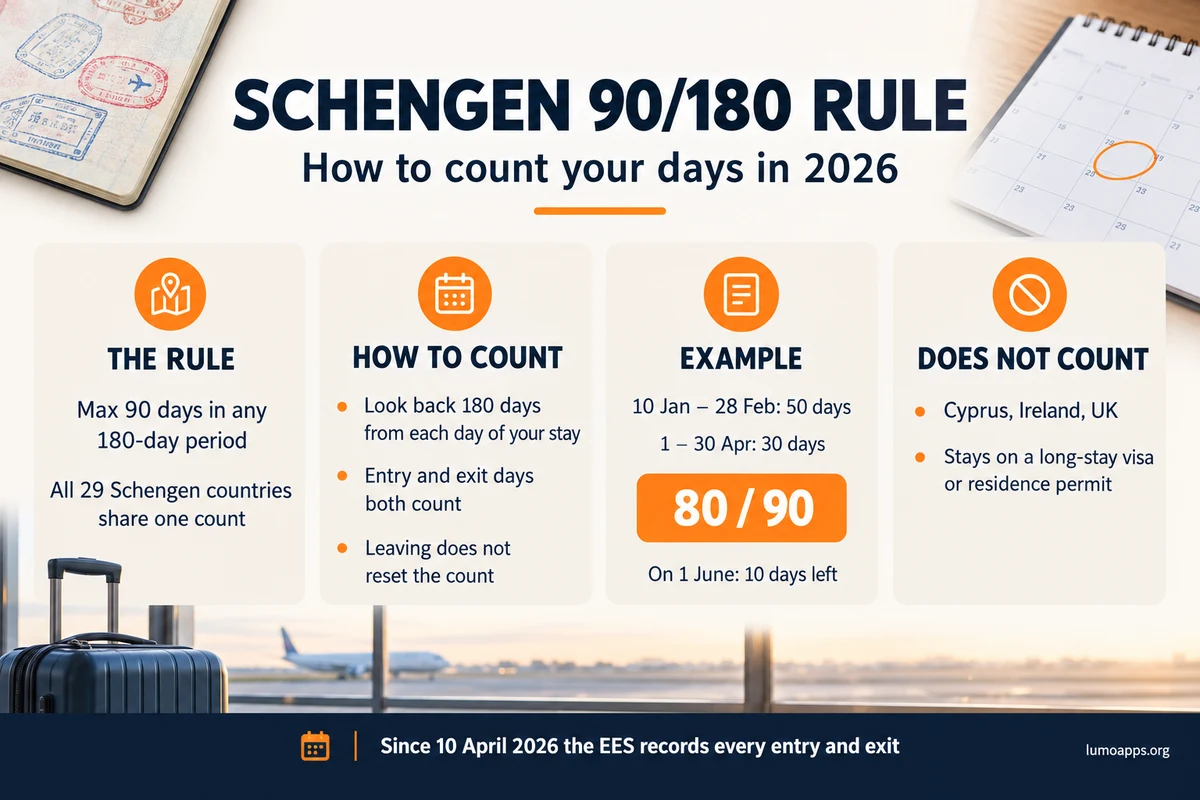
If you visit the Schengen area without a long-stay visa or residence permit, you can stay up to 90 days in any 180-day period. This comes from Article 6 of the Schengen Borders Code, and it applies both to travellers who need a short-stay Schengen visa and to those who can enter visa-free, such as US, UK, Canadian or Australian citizens.
The Schengen area has 29 countries: 25 EU members plus Iceland, Liechtenstein, Norway and Switzerland. Bulgaria and Romania became full members on 1 January 2025. Cyprus and Ireland are EU members but not part of the area, so days there do not count towards your 90.
All 29 countries share one counter. Thirty days in Spain plus thirty in Italy is sixty Schengen days, not two separate counts of thirty.
How to count your days
The 180 days are not a calendar half-year. For every single day of your stay, you look back over the 180 days ending on that day. The number of days you spent in the Schengen area in that window must not exceed 90.
Two details catch most people out:
- Entry and exit days both count. The law treats the day you arrive as the first day of stay and the day you leave as the last, even if you spent only an hour there.
- Leaving does not reset anything. Days only stop counting once they are more than 180 days old. Each day of an old trip drops out of the window on its own date, so your available days come back gradually, not all at once.
Days you spend in a Schengen country on that country's long-stay (D) visa or residence permit are not counted under this rule, so leave those periods out of your calculation.
A worked example
Say you were in the Schengen area from 10 January to 28 February 2026 (50 days) and again from 1 to 30 April 2026 (30 days).
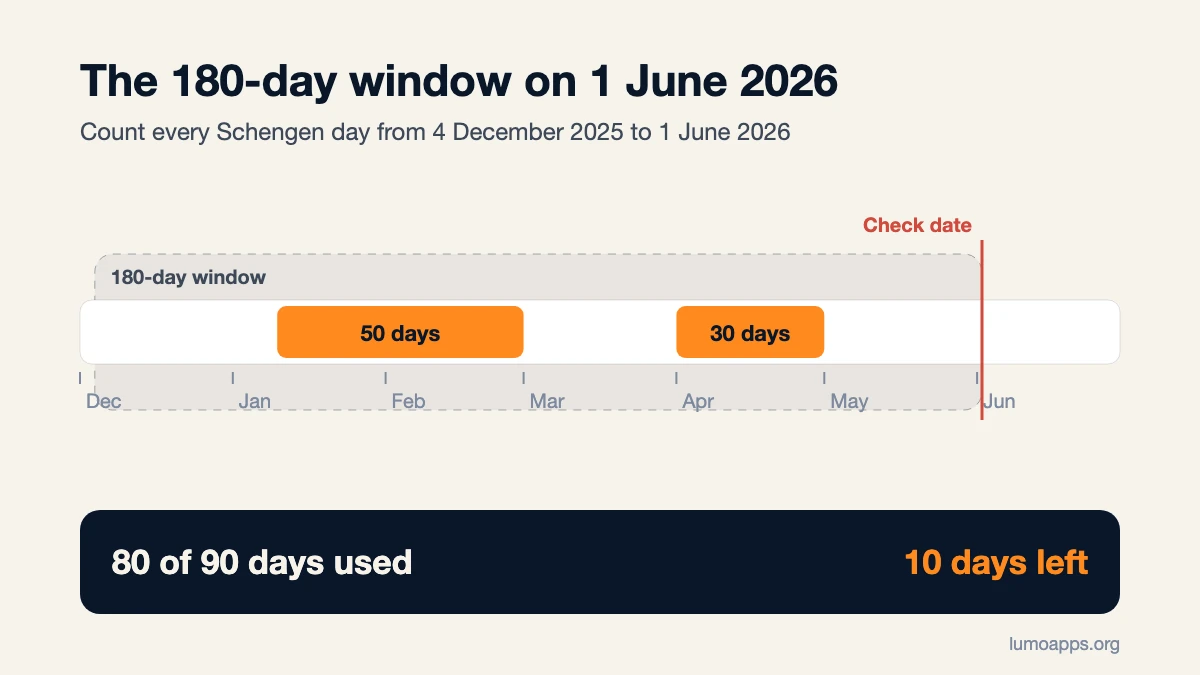 On 1 June 2026 the window runs from 4 December 2025 and holds 80 of your 90 days.
| If you enter on | Days already used | Longest stay from that date |
|---|---|---|
| 1 June 2026 | 80 | 10 days, until 10 June |
| 9 July 2026 | 79 | 60 days, until 6 September |
| 28 August 2026 | 30 | 90 days, until 25 November |
The middle row is the one people get wrong. On 9 July only one day of the January trip has left the window, yet you can stay 60 days, not 11. While you are in the Schengen area, the January and February days keep dropping out one by one, making room for each new day. Once they are all gone, only the April days hold you back.
The last row shows the same effect on a larger scale: by 28 August the winter trip has left the window completely, and the April days drop out while you are there, so a full 90-day stay fits.
Common mistakes
- Thinking a short trip outside Schengen resets the clock. A weekend in London or Istanbul only pauses the count. It does not give you 90 new days.
- Counting each country separately. The 90 days cover the whole area.
- Forgetting the travel days. A trip from Monday to Friday is five days, not four.
- Counting Cyprus or Ireland as Schengen. Days there are not part of the 90.
- Ignoring the limits on your visa. If your Schengen visa allows fewer days or a shorter validity period, the visa limits apply on top of the 90/180 rule.
Some nationalities also have older bilateral visa-waiver agreements with individual Schengen countries that can allow extra time in that one country. These are exceptions with their own conditions, so confirm them with that country's embassy before relying on them.
What changed with the Entry/Exit System
Since 10 April 2026 the EU's Entry/Exit System (EES) has been fully operational and has replaced passport stamping at the external borders of all 29 countries. It records your entries and exits electronically, together with fingerprints and a facial image, and flags overstays to border guards automatically.
In practice, a counting mistake will now be caught at the border. Depending on the country, an overstay can mean a fine, removal and an entry ban. The separate ETIAS travel authorisation for visa-free travellers is not in operation yet; the EU says it will announce the start date several months in advance.
Check your own dates
Counting a rolling window by hand is easy to get wrong. Enter your trips in our free Schengen 90/180 calculator to see how many days you have left and how long you can stay from any date. Before an important trip, double-check the result with the European Commission's official short-stay calculator or the consulate of the country you are going to.
Frequently asked questions
Does the day I arrive count as a full day?
Yes. The day of entry and the day of exit both count as days of stay, whatever time you crossed the border.
Can I stay 90 days, leave for one day and come back for another 90?
No. Leaving only stops new days from being added. The days you have already spent stay in your count until they are more than 180 days old.
Do days in the UK, Cyprus or Ireland count?
No. None of them is part of the Schengen area, so days there do not count towards the 90.
I have a residence permit in one Schengen country. Does the rule apply to me?
Days in the country that issued your permit are not counted. When you travel to other Schengen countries on that permit, the 90/180 limit applies to your stays there.
What happens if I overstay?
Consequences depend on the country and can include a fine, removal and a ban on entering the Schengen area. Since April 2026 the Entry/Exit System detects overstays automatically.
This article is general information, not legal advice. Sources: Schengen Borders Code (Regulation (EU) 2016/399), Article 6; European Commission pages on the Schengen area and the Entry/Exit System.
